Cold Storage Construction in India (Multi-Chamber Step-by-Step Guide)
A multi-chamber cold storage is one of the smartest investments in India’s cold chain—because most businesses don’t store “one product at one temperature.” Farmers’ groups, packhouses, processors, exporters, dairy networks, and pharma distributors often need multiple temperature zones, different turnover speeds, and strict hygiene control. But multi-chamber projects also fail more often when planning is weak. Indian conditions—peak summer heat, monsoon moisture, variable power quality, and high door activity—can turn small construction mistakes into condensation, icing, uneven temperatures, and high electricity bills. This guide explains how to plan and execute cold storage construction for multi-chamber facilities in India, from layout and civil work to insulation, refrigeration integration, and commissioning—so you can build a stable, scalable, bankable asset.
What “Multi-Chamber Cold Storage” Means (And Why It’s Different)
A multi-chamber cold storage is a facility with two or more separate rooms (chambers) designed for different temperature and operational requirements. Typical combinations include:
- Chilled chambers (0–10°C) for fruits, vegetables, dairy, and short-hold storage
- Frozen chambers (-18°C) for frozen foods, meat, seafood
- Ante room / staging / pre-cool zone to reduce infiltration into main chambers
- Packing / grading / dispatch zone to support workflow and hygiene
Why Multi-Chamber Wins in India
- Better product quality (right temp + airflow per commodity)
- Lower spoilage (less cross-contamination and temperature abuse)
- Higher utilisation (rooms match turnover patterns)
- Operational flexibility (store different goods simultaneously)
- Scalable growth (add chambers as demand grows)
Strict mentor rule: Multi-chamber is not “many rooms.” It is a workflow + temperature zoning design, and it must be engineered as a system.
Step 1 — Freeze the Design Basis (Before Any Civil Work)
If you don’t lock the design basis, every quotation becomes random.
Define Your Chamber Plan
For each chamber, document:
- Target temperature range (e.g., +2 to +8, 0 to +10, -18)
- Expected humidity needs (for produce)
- Daily inflow/outflow (throughput matters more than MT alone)
- Door openings per hour (high impact on load)
- Storage duration (short-hold vs long-hold)
Define the Operating Workflow
- Receiving → sorting/grading → pre-cool (optional) → storage → dispatch
- Where will forklifts move?
- Where will doors stay open the most?
- Which chamber needs the highest hygiene control?
India-Specific Site Inputs
- Peak summer ambient (design for worst case, not average)
- Monsoon drainage and waterproofing
- Power reliability (DG/solar/hybrid readiness)
- Water availability (if evaporative condenser/cooling tower is considered)
Step 2 — Layout Planning for Multi-Chamber (The “Profit Design”)
Multi-chamber success is layout-first. A good layout cuts energy waste and improves operational discipline.
Recommended Zones in a Multi-Chamber Facility
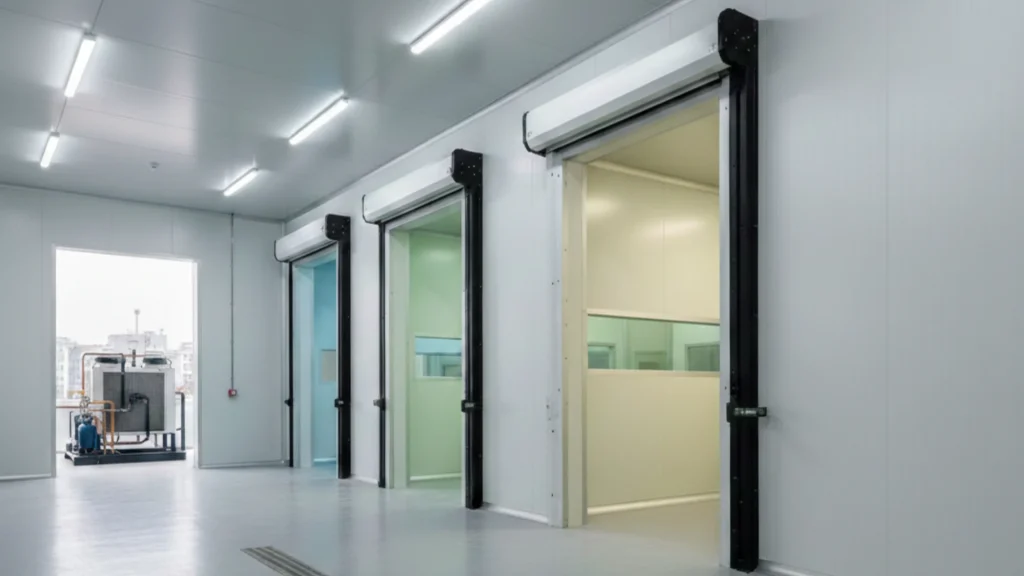
- Ante room (buffer room): reduces warm air entry into cold chambers
- Chilled chambers: separate zones for mixed produce vs dairy vs pharma as needed
- Frozen chamber: ideally isolated to reduce moisture ingress
- Service corridor / pipe corridor: for maintenance access without disturbing operations
- Machine room (compressor room): safe, ventilated, with clear access
- Loading dock: with shelters/air curtains if traffic is high
Layout Mistakes to Avoid
- Chambers opening directly into outdoor yard (infiltration spike)
- Mixed use in one chamber (pharma + produce) without hygiene plan
- No service access (maintenance becomes risky and expensive)
- Long, narrow rooms with poor airflow distribution
Internal-link-ready note: This is where you naturally reference internal pages like “cold room doors,” “PUF/PIR panels,” “dock shelter,” “monitoring systems,” and “refrigeration units.”
Step 3 — Civil Work, Foundation, and Drainage (Monsoon-Proofing)
Foundation & Plinth
- Ensure stable foundation to prevent panel shifting and door misalignment
- Damp-proof course and waterproofing are non-negotiable
- Plan for future expansion (space + structural provisions)
Drainage Design
- External drainage slope away from the building
- Internal drainage for wash-down zones and ante rooms
- Avoid water stagnation near panel joints and door thresholds
Strict warning: Most long-term insulation damage in India starts with water ingress and poor site drainage.
Step 4 — Flooring System (Critical for Multi-Chamber Reliability)
Floor design differs by chamber temperature. Frozen rooms demand stronger insulation and vapor control than chilled rooms.
Typical Cold Storage Floor Layers
- Compacted sub-base
- PCC/RCC base
- Vapor barrier (key element)
- Insulation layer (commonly XPS/PUF based on design)
- Reinforced concrete slab
- Finish (anti-skid / floor hardener where required)
Multi-Chamber Floor Considerations
- Thermal breaks between frozen and chilled zones
- Expansion joints planned correctly (avoid cracking)
- Level differences and thresholds designed for forklift movement
- Drain positions planned for hygiene zones, not inside frozen rooms
Strict mentor rule: If vapor barrier and slab edge insulation are weak, you will fight condensation and ice forever—no matter how big the refrigeration is.
Step 5 — PUF/PIR Panels, Vapor Barrier, and Sealing (Where Quality Shows)
Panel Thickness Strategy (Simplified)
- Chilled chambers: thickness depends on setpoint and ambient
- Frozen chambers: thicker insulation and stronger vapor control
- Roof panels often need extra attention due to solar heat gain
Joint Sealing & Thermal Bridges
- Proper cam-lock joints / sealing methods
- Vapor barrier continuity at corners, slab edges, and door frames
- Avoid metal-to-metal thermal bridges that create sweating and mold
Multi-Chamber Partition Walls
Partition design must prevent:
- Temperature leakage between chambers
- Moisture migration into frozen rooms
- Structural movement leading to gaps over time
Step 6 — Doors, Docking, and Infiltration Control (Energy Leak Control)
In multi-chamber facilities, doors are the biggest operational load driver.
Door Types You’ll Typically Use
- Sliding insulated doors for main chambers
- Hinged doors for small service rooms
- High-speed doors for high-traffic ante rooms (where justified)
Infiltration Control Tools
- Strip curtains / air curtains
- Door closers and interlock discipline (especially for frozen rooms)
- Dock shelters for loading bays
- Clear SOP: “door open time” is a KPI
Strict mentor line: If your business has high traffic, budget for infiltration control—otherwise your monthly power bill will punish you.
Step 7 — Refrigeration System Integration for Multi-Chamber Facilities
Multi-chamber refrigeration is not “one big unit.” It’s capacity distribution, control stability, and redundancy planning.
Design Options
- Centralized plant with multiple evaporators
- Common for larger facilities
- Better control and scalability when engineered properly
- Semi-distributed systems (separate units for chilled vs frozen)
- Good practical control and containment of risk
- Good practical control and containment of risk
- Packaged systems for smaller sites
- Faster installation, simpler operations, but expansion may be limited
- Faster installation, simpler operations, but expansion may be limited
Key Design Must-Haves (India)
- Condenser sized for peak summer ambient
- Voltage/phase protection and safe restart logic
- Independent temperature control per chamber
- Defrost logic suitable for frozen rooms
- Service access and spare planning
Multi-Chamber Control Philosophy
- Each chamber has its own controller + sensors
- Alarm escalation for temperature excursions
- Data logging for business control and audits (especially pharma)
Step 8 — Electrical, Safety, and Monitoring (Business-Grade Setup)
Electrical Essentials
- Proper earthing and protections
- Surge protection and stabilisation plan where grid quality is weak
- DG changeover logic (if DG used)
- Separate circuits for critical controls and monitoring
Monitoring and Alerts (Recommended)
- Temperature data logging per chamber
- Door-open alerts (if feasible)
- Remote alarm notifications for high-temp events
- Energy tracking (kWh/day) for management control
Cold Storage Construction Cost in India (Multi-Chamber Cost Drivers)
There is no single price because costs depend on engineering choices. For multi-chamber facilities, the major cost drivers are:
What Drives CAPEX
- Number of chambers + door count + partition complexity
- Temperature classes (chilled vs frozen vs deep freeze)
- Panel thickness and sealing quality
- Flooring insulation design and vapor barrier detailing
- Refrigeration architecture (centralized vs separate systems)
- Docking and infiltration control (air curtains, shelters)
- Monitoring and compliance requirements
What Drives OPEX (Monthly Power + Maintenance)
- Infiltration due to door habits and poor dock design
- Condenser performance in peak summer
- Wrong equipment sizing (oversized/undersized)
- Poor airflow and stacking discipline inside chambers
ROI Framework for Multi-Chamber Projects (How to Justify Investment)
Multi-chamber ROI typically comes from:
- Lower spoilage and shrinkage
- Better price realisation (holding power)
- Higher throughput efficiency
- Lower energy waste vs mixed-use single chamber
ROI Table (Use for Internal Approval)
ROI Input | What to Estimate | Why It Matters |
Avg daily stock value | ₹/day | Spoilage savings scale with inventory |
Spoilage reduction | % | Core benefit for agri operators |
Energy spend today | ₹/month | Solar/efficiency offsets recurring cost |
Outage impact | hours/day | Drives backup (PCM/battery/hybrid) |
Target temp & turnover | Operational profile | Determines sizing & load |
Strict tip: A multi-chamber design that reduces door-opening losses often delivers ROI faster than “cheaper construction.”
Government Subsidies / Schemes (High-Level, No Speculation)
Subsidy and support can vary by scheme and state implementation. Instead of relying on informal claims, align your project to:
- Cold chain / food processing infrastructure support pathways
- Horticulture-linked post-harvest infrastructure support pathways
- Bank financing and structured DPR-based approvals for cold storage projects
Action step: Prepare a bankable DPR (capacity, chambers, temperature ranges, load assumptions, and cashflow) and validate eligibility through official channels and your financing partner.
Multi-Chamber vs Single-Chamber Cold Storage (Quick Comparison)
Factor | Multi-Chamber | Single-Chamber |
Product flexibility | High | Limited |
Temperature control | Better per commodity | Compromised for mixed goods |
Energy efficiency | Higher when designed well | Can waste energy for mixed loads |
CAPEX | Higher upfront | Lower upfront |
OPEX control | Better with workflow discipline | Often higher if mixed use |
Scalability | Strong (add chambers) | Limited |
Buying Checklist for Multi-Chamber Cold Storage Construction
Technical Checklist
- Load calculation shared and explained per chamber
- Panel thickness + sealing method documented
- Floor insulation + vapor barrier details documented
- Door plan + infiltration control included
- Condenser sized for peak summer ambient
- Control strategy per chamber + alarms + logging
- Commissioning tests written into scope
Commercial Checklist
- Warranty clarity (panels, doors, refrigeration, installation)
- AMC coverage + response time in your state
- Spares plan (critical sensors, controllers, door gaskets)
- Scope clarity (civil, electrical, sheds, drainage, docking)
Site & Operations Readiness
- Drainage and waterproofing verified before panels
- PV/DG readiness if power reliability is weak
- Operator SOPs: door discipline, stacking, hygiene
Commissioning & Acceptance Testing (Don’t Skip)
Minimum Acceptance Tests
- Pull-down time for each chamber
- Temperature uniformity (multiple points)
- Defrost performance in frozen rooms
- Door sealing and infiltration checks
- Alarm and safety checks
- Power interruption behaviour (restart + fail-safe)
Handover Documents
- Layout drawings and as-built
- Refrigeration diagrams and wiring diagrams
- O&M manuals and preventive maintenance schedule
- AMC plan and spares list
FAQ (Featured Snippet Optimized)
1) What is the best layout for multi-chamber cold storage in India?
A practical layout uses an ante room as a buffer, separates chilled and frozen zones, provides service access, and minimises direct outdoor door openings.
2) Why does condensation happen in multi-chamber facilities?
Usually due to poor vapor barrier continuity, panel joint sealing issues, thermal bridges, or frequent door opening without infiltration control.
3) Which is more important—refrigeration or insulation?
Both matter, but insulation quality and sealing decide long-term stability. Refrigeration cannot “fix” vapor barrier and construction mistakes.
4) How do I decide the number of chambers?
Based on product types, temperature ranges, throughput patterns, and hygiene separation needs. More chambers improve flexibility but must match operational discipline.
5) What commissioning proof should I ask for?
Pull-down test, temperature uniformity logs, defrost verification, and alarm/safety testing—documented per chamber.
6) Can multi-chamber cold storage reduce electricity cost?
Yes—if chambers are sized correctly, airflow is designed well, and door/infiltration losses are controlled through layout and SOPs.
Professional CTA (Trust-Building)
If you’re planning a multi-chamber cold storage construction project in India, don’t compare quotations without a specification and layout plan.
- Request a quote based on chamber count, target temperatures, and location
- Talk to cold chain experts to validate panel thickness, floor insulation, condenser sizing, and controls
- Explore complete cold room solutions (panels, doors, refrigeration units, docking, monitoring) to reduce project risk