
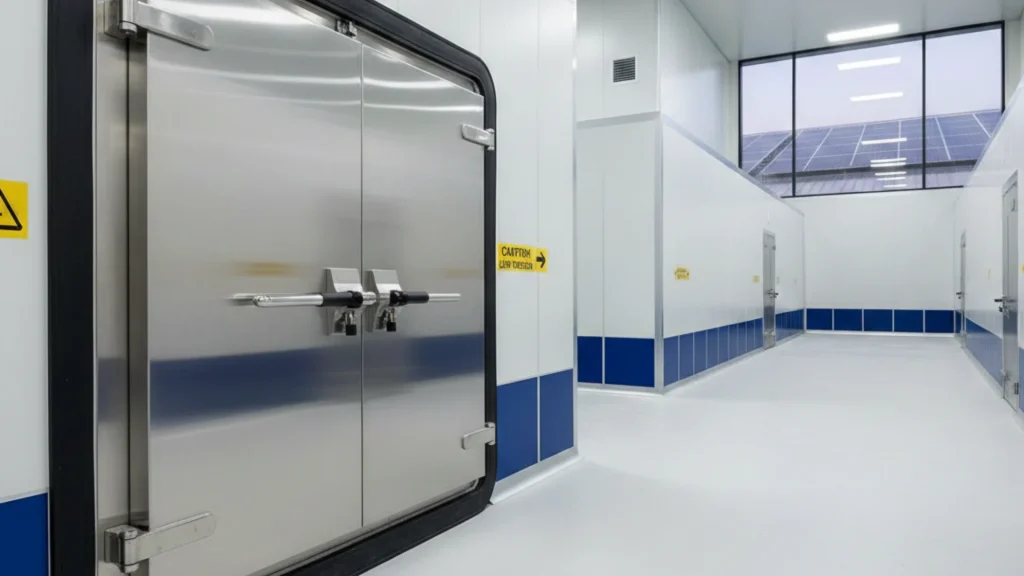
Gas Tight Doors for CA Cold Storage in India
The Controlled Atmosphere (CA) cold storage system requires gas tight doors as an essential component for storing apples and other high-value fruits. The CA storage system requires operators to maintain low oxygen (O₂) levels while controlling carbon dioxide (CO₂) levels throughout the entire storage period. The atmosphere becomes unstable and operational costs rise while fruit quality decreases whenever doors develop even minor air leaks because of their incorrect design or installation.
This guide explains what gas tight doors are, how they work, where they are used, and what Indian cold storage decision-makers should check before buying.
What Are Gas Tight Doors?
A gas tight door is a specialised insulated door engineered to minimise air exchange between the CA chamber and the outside environment. Unlike standard cold room doors, it is built to:
- maintain airtight sealing under pressure differences
- reduce oxygen ingress and CO₂ leakage
- withstand long-duration storage conditions
- support stable temperature + humidity + atmosphere control
In practical CA operations, the door is one of the most common leakage points. A gas tight door is designed to reduce that risk.
Where Gas Tight Doors Are Used in Cold Chain Projects
Gas tight doors are mainly used in:
- CA cold storage chambers for apples (long-hold storage)
- Fruit CA/MA chambers for pears, kiwi, and selected high-value crops
- CA pre-conditioning rooms where atmosphere must stabilise fast
- CA ante-room systems where leakage control is critical
If your project is CA, a normal cold room door is not “good enough.” It will leak over time.
How Gas Tight Doors Work
A CA gas tight door combines insulation with engineered sealing. The performance depends on four things:
1) Multi-point Sealing
The door typically uses a continuous gasket system that compresses evenly around the entire perimeter to prevent air gaps.
2) Compression Hardware (Locking)
Gas tight doors often use lever locks / multi-point locking that creates uniform compression on the gasket.
3) Insulated Leaf + Thermal Break
The door leaf is insulated to reduce heat gain and avoid condensation issues. Proper thermal break design helps maintain sealing integrity.
4) Frame & Threshold Design
Frame alignment and threshold sealing are critical. Many CA failures happen because of poor frame installation—not because the door is “bad.”
Strict tip: In CA projects, door performance is as much about installation quality as product quality.
Types of Gas Tight Doors for CA Storage
Hinged Gas Tight Doors
Best when:
- door opening frequency is low
- chamber sizes are moderate
- you want a simpler mechanical system
Pros: robust sealing, simpler maintenance
Cons: needs clear swing area, hinge alignment must be perfect
Sliding Gas Tight Doors
Best when:
- opening width is large
- space is limited
- you want easier movement for crates/pallets
Pros: space-saving, suitable for larger openings
Cons: track/roller alignment is critical; sealing must be engineered well
Materials & Construction (What Matters in India)
For Indian CA cold storage projects, look for:
- Insulated core: PUF/PIR (thickness aligned with chamber design)
- Skin options: PPGI / SS (stainless steel for higher hygiene and corrosion resistance)
- Gaskets: durable, continuous, and replaceable
- Hardware: corrosion-resistant locks, hinges/rollers, handles
- Frame: rigid frame with correct anchoring to avoid long-term misalignment
Avoid: low-grade gaskets and lightweight frames. They fail first.
Key Specifications to Check Before Buying
Use this checklist for vendor comparison (quote-ready):
Airtightness & Leakage Control
- Door sealing method and gasket design
- Locking system and compression points
- Door-frame contact uniformity
Door Size & Opening Type
- clear opening width/height
- hinged vs sliding
- traffic pattern (crates/pallet movement)
Insulation & Condensation Control
- insulation thickness
- anti-condensation measures (if required)
- thermal bridging risk at frame and threshold
Hardware & Serviceability
- spare gasket availability
- lock/hinge/roller replacement ease
- AMC/service support for your region
Strict tip: Ask the vendor to confirm installation method + acceptance checks in writing.
Common Problems in Indian CA Cold Storages (And How to Avoid Them)
1) Gasket Wear and Leaks
Cause: frequent opening, poor gasket material, uneven compression
Fix: choose replaceable gaskets + proper locking compression
2) Misalignment Over Time
Cause: weak frame anchoring, poor civil finishing, vibration
Fix: rigid frame, correct anchoring, periodic alignment checks
3) Condensation at Door Edge
Cause: thermal bridge, poor insulation continuity
Fix: thermal break design, correct insulation thickness, proper sealing
4) Improper Installation
Cause: rushed commissioning, untrained installers
Fix: insist on commissioning checklist and door performance test
Installation & Maintenance Checklist (Use This as SOP)
Installation Checklist
- frame installed plumb and square
- threshold sealing completed without gaps
- gasket compression uniform across perimeter
- locks/rollers tested under full closure
- chamber pressure/atmosphere readiness verified
Maintenance Checklist
- inspect gasket weekly during peak season
- clean gasket and contact surfaces
- check lock tension and alignment monthly
- replace worn gaskets before storage season
- maintain a spare gasket + basic hardware kit onsite
Gas Tight Doors vs Standard Cold Room Doors
Feature | Gas Tight Door (CA) | Standard Cold Room Door |
Airtight sealing | High (compression gasket + locks) | Moderate |
Atmosphere stability | Suitable for CA | Not reliable for CA |
Locking mechanism | Multi-point compression | Basic latch/lock |
Installation sensitivity | Very high | Moderate |
Best use | CA fruit storage | Chilled/frozen rooms |
Conclusion: For CA, a standard door is a shortcut that usually becomes a loss.
Buying Checklist (Fast Vendor Evaluation)
Before you finalise a supplier, confirm:
- door type: hinged/sliding and exact opening size
- gasket type + spare availability
- locking/compression design
- installation scope included or excluded
- warranty terms (gasket/hardware clarity)
- service support in your state
- commissioning & acceptance checks
FAQ (Featured Snippet Friendly)
1) What is a gas tight door in CA cold storage?
A gas tight door is an insulated, airtight door designed to minimise air leakage so the CA chamber can maintain controlled O₂ and CO₂ levels.
2) Why is a gas tight door important for apple CA storage?
Apples require stable CA conditions for long-hold storage. Door leakage disrupts atmosphere control and can reduce fruit quality and shelf life.
3) Hinged or sliding—what is better for CA chambers?
Both work. Hinged suits low traffic and simpler setups; sliding suits larger openings and space constraints. The deciding factor is sealing + installation quality.
4) How do I know if my CA door is leaking?
Common signs include unstable CA gas readings, frequent correction cycles, and visible gasket gaps. A proper inspection and sealing test is recommended.
5) What should I ask in a quotation for gas tight doors?
Ask for opening size, insulation thickness, gasket type, locking system, installation scope, warranty, and commissioning checks.
Professional CTA (Trust-Building)
When you want to evaluate doors for your CA apple cold storage project you should not base your decision on door prices alone. The evaluation process should include assessment of sealing design and installation method and service support.
- Request a quote with chamber size, door opening, and CA requirement
- Talk to cold chain experts to validate sealing and commissioning checks
- Explore compatible cold storage components to ensure system-level performance